Ravenclaw vs Slytherin: Key Differences and Which You Are
Ravenclaw and Slytherin are both 'clever' houses, which makes them easy to confuse. The real difference is what each one uses its intelligence for. A side-by-side guide with a quick self-test.
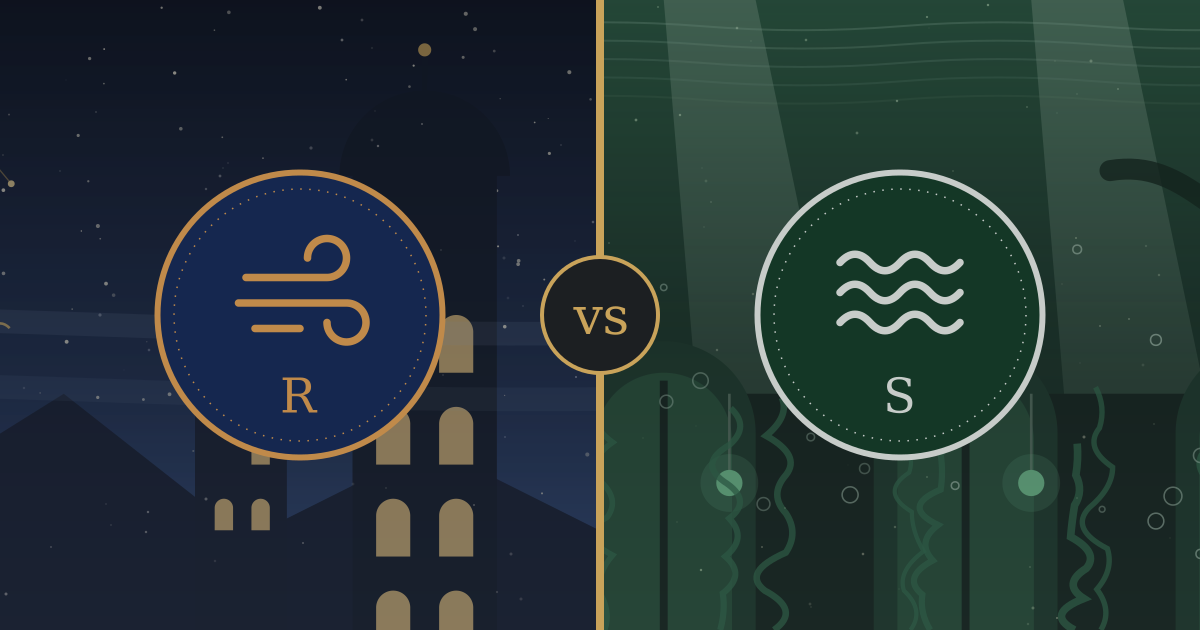
If you’ve taken a house quiz and found Ravenclaw and Slytherin neck and neck, you’re not alone. These are the two “clever” houses, and people who score high on one often score high on the other.
The difference isn’t how intelligent you are. It’s what you do with your intelligence. This guide breaks down that difference trait by trait, with examples from the books and a quick self-test at the end.
The one-sentence difference
A Ravenclaw wants to understand something. A Slytherin wants to achieve something.
Give both a locked door. The Ravenclaw wonders how the lock works. The Slytherin wonders what’s behind the door, who has the key and what they’d want in exchange for it.
Side-by-side comparison
| Ravenclaw | Slytherin | |
|---|---|---|
| Core value | Intelligence, wit, creativity | Ambition, cunning, resourcefulness |
| Founder | Rowena Ravenclaw | Salazar Slytherin |
| Colours | Blue and bronze | Green and silver |
| Animal | Eagle | Serpent |
| Element | Air | Water |
| House ghost | The Grey Lady | The Bloody Baron |
| Common room | West tower, entered by answering a riddle | Dungeons under the lake, entered with a password |
| Motivation | Curiosity | Achievement |
| Relationship with rules | Questions rules that don’t make sense | Uses rules that work in their favour |
| Social style | Independent, sometimes aloof | Networked, loyal to their circle |
| Under pressure | Analyses | Adapts |
| Typical flaw | Intellectual pride | Ruthlessness |
What each house values
Ravenclaw: knowledge as the goal
Rowena Ravenclaw was said to value intelligence above everything. Her house welcomes students with quick minds, original ideas and a love of learning for its own sake.
The common room entrance captures this perfectly. There’s no password. A bronze eagle knocker asks a riddle, and you get in by giving a thoughtful answer. In Deathly Hallows, when the knocker asks Luna and Harry a question, it accepts a well-reasoned answer, not just the “right” one. Ravenclaw rewards thinking, not memorising.
Slytherin: knowledge as a tool
Salazar Slytherin valued ambition, cunning and resourcefulness. Intelligence matters in Slytherin, but as a means to an end. Slytherins learn what they need to get where they’re going.
Their common room needs a password, and it sits deep in the dungeons under the Black Lake. It’s a space for people who already belong. Slytherin values networks, reputation and knowing the right people. Horace Slughorn, a Slytherin and Head of House, spent his career collecting promising students for his “Slug Club” precisely because connections are power.
How each house handles the same situation
A difficult exam
- Ravenclaw: studies the topic in depth because it’s genuinely interesting, and might get distracted by a tangent.
- Slytherin: studies what’s likely to come up, finds out how the examiner marks, and aims for the result.
A secret
- Ravenclaw: wants to know it.
- Slytherin: wants to use it.
A rule that seems pointless
- Ravenclaw: points out, sometimes loudly, why it makes no sense.
- Slytherin: follows it in public and works around it in private.
A rival
- Ravenclaw: might not notice there’s a competition.
- Slytherin: has already noticed, and has a plan.
Characters who show the difference
Luna Lovegood (Ravenclaw)
Luna is the purest Ravenclaw in the series. She believes in creatures nobody else has seen, reads The Quibbler upside down, and doesn’t care at all what others think of her. Her ideas aren’t always right, but they’re always her own. She isn’t trying to win anything with them.
Severus Snape (Slytherin)
Snape is one of the most brilliant characters in the books. As a teenager he improved potion recipes in the margins of his textbook and invented his own spells, signing himself the Half-Blood Prince. But he used that brilliance strategically: to gain status, to survive as a double agent and to protect the one person he cared about. That’s Slytherin intelligence.
Gilderoy Lockhart (Ravenclaw gone wrong)
Lockhart shows how Ravenclaw cleverness can turn hollow. He was talented at one thing, memory charms, and used it to steal credit for other wizards’ deeds. He wanted the reputation of a scholar without doing the work. Notice that his motive was fame, which looks almost Slytherin. The Hat seems to have judged that his vanity about his own cleverness was the stronger trait.
Tom Riddle (Slytherin at the extreme)
Tom Riddle was brilliant enough for Ravenclaw. He was top of his year, charmed teachers and researched obscure magic with real dedication. Famously, he tracked down the lost diadem of Ravenclaw by charming the Grey Lady into telling him where it was. But he used every bit of that knowledge for power and immortality. Ambition was always the master.
Strengths and weaknesses
Ravenclaw at its best and worst
Best: original, curious, fair-minded and open to unusual people and ideas.
Worst: aloof, smug and cliquey. In Order of the Phoenix, other Ravenclaws repeatedly hide Luna’s belongings. Being clever doesn’t stop a group from being unkind to someone who doesn’t fit.
Slytherin at its best and worst
Best: focused, resourceful, protective of its own and good at getting things done.
Worst: ruthless and status-obsessed, and historically tied to pure-blood prejudice. Many of Voldemort’s followers were Slytherins.
Famous members compared
| Role | Ravenclaw | Slytherin |
|---|---|---|
| Founder | Rowena Ravenclaw | Salazar Slytherin |
| Head of House (Harry’s era) | Filius Flitwick | Severus Snape, later Horace Slughorn |
| Best-known student | Luna Lovegood | Tom Riddle |
| Famous craftsman or scholar | Garrick Ollivander (wandmaker) | Horace Slughorn (Potions master) |
| Cautionary tale | Gilderoy Lockhart | Bellatrix Lestrange |
| House ghost | The Grey Lady | The Bloody Baron |
The two ghosts are a neat summary of the rivalry between ambition and intellect. The Grey Lady stole her mother’s diadem because she wanted to be cleverer. The Baron killed her because he couldn’t accept her refusal. Both were destroyed by wanting something too much.
Ravenclaw vs Slytherin careers
Both houses produce high achievers, but in different fields.
| Ravenclaw | Slytherin | |
|---|---|---|
| Typical careers | Research, teaching, wandmaking, writing, invention | Politics, business, law, leadership |
| Ideal job | Somewhere they can follow their curiosity | Somewhere they can rise to the top |
| Work style | Independent, deep focus | Strategic, networked |
| Motivated by | Interesting problems | Status and influence |
A quick self-test
Answer these honestly. Count which column you lean towards more often.
| Question | Ravenclaw answer | Slytherin answer |
|---|---|---|
| Would you rather know a secret or use it? | Know it | Use it |
| What makes a good day? | Learning something new | Getting closer to a goal |
| How do you pick friends? | People who interest you | People you trust and who help you grow |
| How do you feel about being the odd one out? | Fine with it | You’d rather be in the inner circle |
| What’s success? | Understanding | Achievement |
| You find a mistake in a textbook. | Tell the teacher because it’s wrong | Keep it to yourself as an advantage in the exam |
Mostly Ravenclaw answers? Read the Ravenclaw guide. Mostly Slytherin? Read the Slytherin guide. Evenly split? You may be close to a hatstall.
Why the two are often confused
Pop culture has flattened both houses. Ravenclaw becomes “the smart house” and Slytherin becomes “the evil house”. With those labels, a clever, ambitious person can’t tell where they belong.
The books are more precise. Both houses have intelligent members. The question is whether you’re drawn to ideas for their own sake, or to what those ideas can get you. One quality isn’t better than the other. They’re just different engines.
Find out which one you are
Our house quiz includes questions that separate these two houses, like what you’d do with a locked door or an unearned promotion. Your result shows a score for every house, so you can see exactly how close your Ravenclaw and Slytherin sides are.
For the other big rivalry, see Gryffindor vs Slytherin.
Frequently asked questions
Can you be both Ravenclaw and Slytherin?
Many people have strong traits of both. The Sorting Hat has to pick one, usually based on which value matters more to you. If you score closely on both, you'd be a near-hatstall.
Is Ravenclaw smarter than Slytherin?
Not necessarily. Ravenclaw values intelligence for its own sake. Slytherin values it as a tool. Severus Snape, a Slytherin, invented spells as a teenager; plenty of Slytherins are brilliant.
Which house is more independent?
Ravenclaw. Ravenclaws are often comfortable alone and indifferent to what others think. Slytherins value their network and tend to stick closely to their own.
Are Ravenclaw and Slytherin rivals?
Not in the way Gryffindor and Slytherin are. The books give them no major rivalry, though they compete in Quidditch and for the House Cup.
Which famous characters could have gone either way?
Fans often debate Severus Snape, who had a scholar's mind, and Tom Riddle, whose brilliance and ambition were both exceptional. Both were sorted into Slytherin, which suggests the Hat judged ambition to be their stronger value.