What Is the Best Hogwarts House? All Four Compared
There is no official best Hogwarts house, but each one wins on different measures. We compare Gryffindor, Ravenclaw, Hufflepuff and Slytherin on values, famous members, track record and flaws.
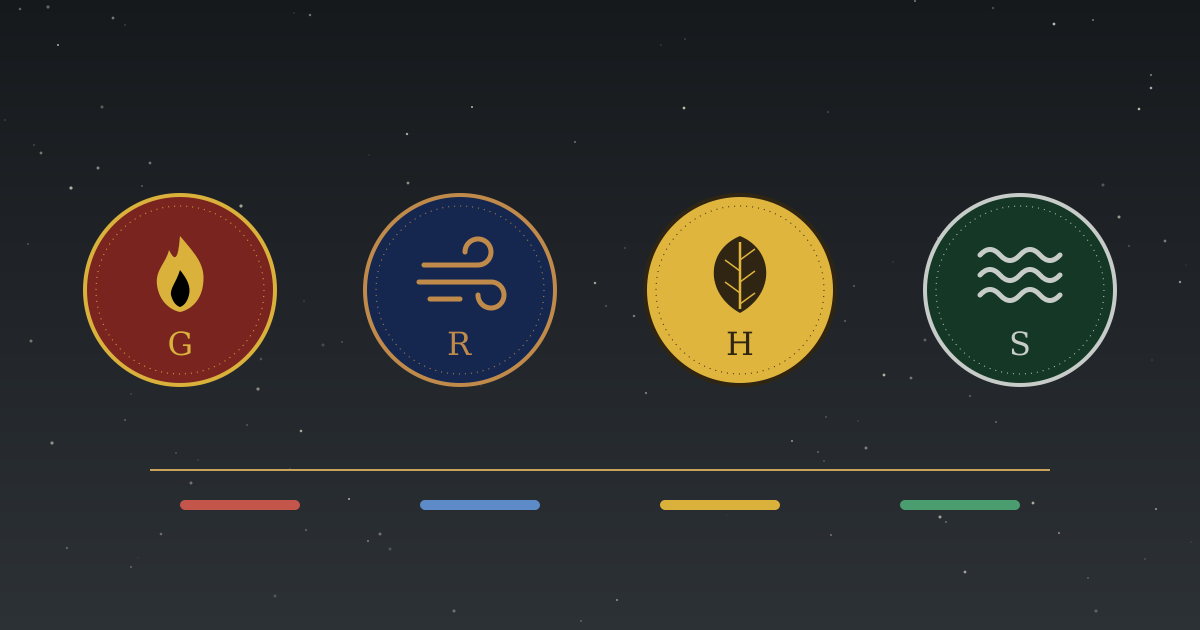
Fans have argued about the best Hogwarts house for as long as the books have existed. The honest answer is that there isn’t one. J.K. Rowling’s stories go out of their way to show every house at its best and its worst. What you can do is compare the houses on specific measures: what they value, who they produced, how they behaved when it mattered and what they tend to get wrong.
That’s what this guide does. By the end you’ll know which house wins on each measure, and which one is the best fit for you.
The short answer
If you want a single verdict, here’s how the houses stack up on the measures fans care about most:
| Measure | Winner | Why |
|---|---|---|
| Heroism in a crisis | Gryffindor | Most of the people who defeat Voldemort were sorted there |
| Moral track record | Hufflepuff | Known for producing the fewest dark wizards |
| Original thinking | Ravenclaw | The house of inventors, scholars and unusual minds |
| Getting results | Slytherin | Ambitious, organised and good at reading people |
| Loyalty | Hufflepuff | Its founder chose fairness over any single talent |
| Most misunderstood | Slytherin | Judged by its worst members rather than its average one |
No house wins everything. That’s deliberate. Each house is built around one quality, and every quality has a shadow side.
How we’re comparing them
The four founders of Hogwarts each valued a different quality in students:
- Godric Gryffindor valued courage.
- Rowena Ravenclaw valued intelligence and wit.
- Helga Hufflepuff valued loyalty and hard work, and said she would teach everyone.
- Salazar Slytherin valued ambition and cunning, and wanted only pure-blood students.
So “best” depends on which of those qualities you rate most highly. Below, each house gets the same treatment: its strongest case, its weakest point and its notable members. Then we compare them head to head.
The case for Gryffindor
Gryffindor has the strongest claim to being the “hero house”. Harry Potter, Hermione Granger, Ron Weasley, Neville Longbottom, Ginny Weasley, Albus Dumbledore and Minerva McGonagall were all Gryffindors. So were most of the original Order of the Phoenix.
When the series reaches its climax, Gryffindors are disproportionately the ones taking the biggest risks. Neville destroys the last Horcrux. Harry walks into the Forbidden Forest expecting to die. Ron and Hermione destroy a Horcrux in the Chamber of Secrets.
Where Gryffindor falls short: recklessness. A lot of Gryffindor plans succeed because of luck or because someone else, often Hermione, did the preparation. The house also produced Peter Pettigrew, whose betrayal led to the deaths of James and Lily Potter. Courage is not the same as goodness.
Best for: people who act on principle, stand up for others and would rather fail at something brave than succeed at something safe.
Read the full Gryffindor guide.
The case for Ravenclaw
Ravenclaw values intelligence, but it’s more interesting than a house for good exam results. Its best members think for themselves. Luna Lovegood is the obvious example: she believes in things nobody else does, is unbothered by what people think of her, and is often the first to notice what others miss.
The house’s common room is guarded by a riddle rather than a password, which tells you what it values. You get in by thinking, not by knowing the right word.
Where Ravenclaw falls short: intelligence without kindness. Gilderoy Lockhart was a Ravenclaw who used his one real talent, memory charms, to steal other people’s achievements. Ravenclaw students also bully Luna throughout the books, hiding her belongings, which shows the house can be cliquey and dismissive of anyone too unusual.
Best for: curious people who love ideas, are comfortable being alone and care more about understanding something than winning with it.
Read the full Ravenclaw guide.
The case for Hufflepuff
Hufflepuff has the strongest moral case. Helga Hufflepuff refused to pick students for a single talent and said she would teach them all. The values that followed are loyalty, fairness, patience and hard work.
The house is well known for producing fewer dark witches and wizards than any other. And at the Battle of Hogwarts, when younger students were sent away, many Hufflepuffs chose to stay and fight. They weren’t doing it for glory. They did it because the people they cared about were there.
Famous members include Cedric Diggory, the Hogwarts Triwizard champion, Nymphadora Tonks, an Auror, and Newt Scamander, author of the standard textbook on magical creatures.
Where Hufflepuff falls short: it can be too trusting and too modest. Hufflepuffs rarely push for recognition, which is part of why the house is underrated even inside the books.
Best for: people others rely on, who play fair and finish what they start. See also why Hufflepuff is the most underrated house.
The case for Slytherin
Slytherin is the house of ambition, cunning and resourcefulness. Its members are good at planning, reading people and getting what they want. Those are useful qualities in almost any field.
The strongest argument for Slytherin is Severus Snape. He spent years as a double agent, lying to the most dangerous wizard alive, to protect the son of the woman he loved. Few characters in the series show more sustained bravery. Narcissa Malfoy’s single lie to Voldemort in the Forbidden Forest also helps decide the war.
Where Slytherin falls short: the house’s history with blood purity, and its most infamous member, Lord Voldemort. Many of his Death Eaters, including Bellatrix Lestrange, were Slytherins. Ambition with no moral limit is the house’s greatest danger.
Best for: driven people who plan ahead, adapt quickly and fiercely protect their own.
Read the full Slytherin guide.
Head-to-head comparison
Here’s how the four houses compare on the details that come up most in fan debates:
| Gryffindor | Ravenclaw | Hufflepuff | Slytherin | |
|---|---|---|---|---|
| Core value | Courage | Intelligence | Loyalty | Ambition |
| Founder | Godric Gryffindor | Rowena Ravenclaw | Helga Hufflepuff | Salazar Slytherin |
| Colours | Scarlet and gold | Blue and bronze | Yellow and black | Green and silver |
| Animal | Lion | Eagle | Badger | Serpent |
| Common room entry | Password to a portrait | Answer a riddle | Tap a barrel rhythm | Password to a stone wall |
| Typical strength | Acts when others hesitate | Sees what others miss | Shows up for others | Plans and gets results |
| Typical flaw | Reckless | Aloof | Too trusting | Ruthless |
| Best-known member | Harry Potter | Luna Lovegood | Cedric Diggory | Severus Snape |
Common myths about each house
A lot of “best house” arguments rest on stereotypes the books don’t support. Here are the most common ones.
“Gryffindors are the good guys”
Gryffindor produced most of the heroes, but not all Gryffindors are heroic. Peter Pettigrew betrayed his closest friends to Voldemort. Even the heroes have blind spots: as teenagers, James Potter and Sirius Black bullied Snape, and Harry himself admits he was ashamed of what he saw in Snape’s memory. Courage is a Gryffindor’s defining quality. Kindness isn’t guaranteed.
“Ravenclaws are just nerds”
Ravenclaw values wit, creativity and wisdom as much as knowledge. Its notable members include a wandmaker, Garrick Ollivander, and a teacher famous for his charm and humour, Filius Flitwick, who was also a duelling champion. The stereotype of the quiet bookworm misses the creative, eccentric side of the house.
“Hufflepuff is for leftovers”
This comes from a single throwaway line about Hufflepuffs being a lot of duffers, said by Hagrid before Harry even reaches Hogwarts. It isn’t the books’ verdict. Helga Hufflepuff’s openness was a deliberate choice, and her house’s record in the final battle speaks for itself.
“Slytherins are all dark wizards”
Slytherin’s reputation comes from its worst members and from its founder’s views on blood purity. But the house also gave the series Horace Slughorn, who returns to fight at the Battle of Hogwarts, and Snape, whose courage drives the whole plot. By the time Harry’s son Albus starts school, Harry tells him that if he ends up in Slytherin, the house will be lucky to have him.
Do the houses ever work together?
The books suggest the school is strongest when the houses cooperate. Dumbledore’s Army in Order of the Phoenix drew members from Gryffindor, Ravenclaw and Hufflepuff. At the Battle of Hogwarts, students and teachers from every house, including Slughorn, fought on the same side.
The House Cup and Quidditch encourage rivalry, and that’s part of the fun. But the series ends with former enemies standing on the same platform at King’s Cross, sending their children off to a school where any of them could end up in any house. If there is a lesson about the “best” house, that’s it.
Which house would you want on your side?
Another way to settle the debate is to ask which house you’d want for a particular job:
- In a fight against a dark wizard: Gryffindor. They’ll show up first and stay to the end.
- To solve a problem nobody understands: Ravenclaw. They’ll find the angle everyone missed.
- As a friend in a hard year: Hufflepuff. They’ll still be there when it’s over.
- As a business partner: Slytherin. They’ll have a plan, a backup plan and an exit.
Seen this way, the houses aren’t ranked. They’re specialised.
What the books suggest
The series repeatedly undermines the idea of a superior house. A few examples:
- The Sorting Hat warns against division. In Order of the Phoenix its song pleads with the houses to unite, because splitting into factions weakens the school.
- Dumbledore questions the Sorting itself. In Deathly Hallows he tells Snape he sometimes thinks they sort too soon.
- Harry names a son after a Slytherin. In the epilogue, Harry tells his son Albus Severus that he was named after two Hogwarts headmasters, one of them a Slytherin and probably the bravest man Harry knew.
The message is consistent. Houses describe what you value. They don’t decide whether you’re good.
So which is the best house for you?
The only meaningful “best house” is the one that fits you. To find yours, think about which of these sounds most like you on a normal day:
- You’d rather do the right thing than the easy thing, even with nobody watching. Gryffindor.
- You’d rather understand how something works than be told the answer. Ravenclaw.
- You’d rather everyone was treated fairly than that you came out on top. Hufflepuff.
- You’d rather have a plan and a goal than leave things to chance. Slytherin.
If two of those sound equally like you, you may be close to what the books call a hatstall. Our house quiz shows your score for all four houses, so you can see how close the race is.
Frequently asked questions
What is the most popular Hogwarts house?
Gryffindor is generally the house fans most often want, largely because Harry, Hermione and Ron are in it. Popularity polls vary, and in recent years Slytherin and Hufflepuff have both gained fans as readers re-evaluate them.
What is the least popular Hogwarts house?
Hufflepuff has traditionally been seen as the least glamorous house, and even characters in the books joke about it. Many fans now argue it is the most underrated house rather than the weakest.
Is Slytherin the evil house?
No. Slytherin produced more dark wizards than other houses, but the house values ambition, cunning and resourcefulness, none of which are evil in themselves. Severus Snape, Horace Slughorn and, by tradition, Merlin were all Slytherins.
Which house has won the House Cup the most?
The books don't give a full history. We know Slytherin won six years in a row before Harry's first year, when Gryffindor broke the run on the final night.
Which house is best for smart people?
Ravenclaw is built around intelligence, but clever students end up in every house. Hermione Granger, the brightest witch of her year, is a Gryffindor because the Sorting Hat judged that she valued doing what's right even more than learning.